
Home,
Auto Repair Library, Auto Parts,
Accessories, Tools,
Manuals & Books, Car BLOG,
Links, Index

How to Diagnose Battery, Starter & Charging System
Copyright AA1Car
When temperatures drop, no-start problems only get worse. Cold weather increases the strain on the battery, starting and charging system and tends to bring out any weaknesses in these components.
Cold weather thickens the oil and makes the engine harder to crank. Normal cranking loads can require 125 to 200 amps or more from the battery depending on engine displacement, compression and temperature. At 0 degrees F, that number can increase 200 to 250 percent depending on the viscosity of the oil in the crankcase.
At the same time, freezing temperatures also sap the battery's ability to supply amps. At 0 degrees F, most batteries can deliver only about 65 percent of their normal cranking amps. At -20 degrees F, battery power is cut in half!
A battery cannot deliver maximum cranking power if it is not maintained at or near full charge - especially when outside temperatures drop and reduce the battery's amp output. So reliable starting also requires a good charging system that can keep the battery fully charged and also supply enough amps to meet all of the other electrical needs.
If the battery is low or getting old, the starter is weak or there is too much resistance in the starting circuit, the combination of increased cranking load and reduced battery capacity may prove to be too much when temperatures drop. The engine may not crank fast enough to start, or it may not crank at all.
START WITH THE BATTERY
The first thing you should always check when diagnosing a no-start problem is the condition of the battery and state-of-charge. The battery may be run down, but a good battery will accept and hold a charge, and deliver the rated number of amps on demand. A bad battery won't accept a charge and cannot supply its normal supply of amps because the cells are damaged or worn out.
Testing Battery Voltage and State-of_Charge
Use a voltmeter to check battery charge, even if it has a built-in charge indicator. Built-in charge indicators only read one cell, not all six cells. If another cell is bad, you cannot tell by looking at the charge indicator.
A fully charged battery should read over 12.6 volts. A reading of 12.45 volts equals about a 75 percent charge and is good enough for further testing. But anything less means the battery is low and needs to be recharged.
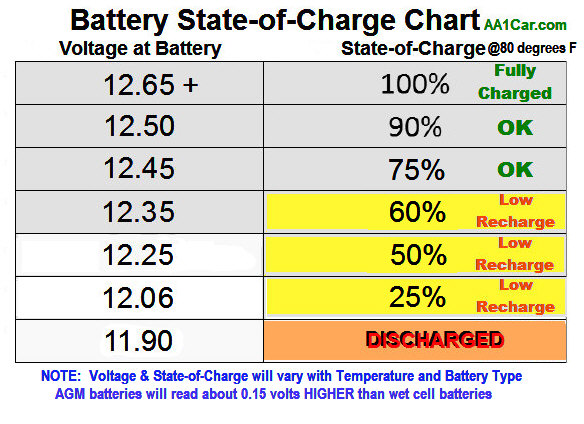
(NOTE: these readings are at 80 degrees F. Battery voltage readings will
drop with temperature roughly 0.01 volts for every 10 degrees F.)
(At 30 degrees F. a fully charged battery will measure about 12.588 volts, and at zero degrees F it will measure about 12.516 volts.)
Lead-acid batteries must be maintained at or near full charge to prevent deterioration of the lead plates inside. If the battery is allowed to sit more than a couple of days in a discharged condition, the plates can become sulfated and may not fully recover when the battery is recharged. This will reduce battery output as well as shorten its service life.
If the battery is run down or dead, you will have to test it to see if it is good or bad. If you have a carbon pile battery tester, you will have to recharge the battery before you test it to get accurate results. Do not attempt to recharge a battery if it is frozen. Let it sit until it thaws, then check the electrolyte level. If the level is okay, then hook up your charger and see if it will accept a charge.
When a load test is applied to the battery (typically half the battery's cold cranking amp [CCA] capacity or three times its amp/hour rating), battery voltage should remain above 9.6 volts. If it can't maintain the minimum voltage, the battery is probably bad. To be sure, you can recharge and retest it, or give it a three-minute charge test.
A three-minute charge test checks for a sulfated battery. This test requires slow charging the battery at 40 amps for six minutes, then checking the voltage across the terminals with the charger on. If the voltage is above 15.5 volts, the battery is not accepting a charge. Slow charging for 20 hours can sometimes reverse the sulfate condition and save the battery. Otherwise, the battery will have to be replaced.
A faster and easier way to check a battery is to use an electronic battery tester that does not require a fully charged battery for accurate test results. Some electronic battery testers measure battery conductance to reveal its condition. Sending a frequency signal through the battery reveals how much plate area is available to hold and deliver power. As a battery ages, its conductance declines. Shorts, opens and other cell defects also affect conductance, so measuring it gives an accurate indication of battery condition.
Many electronic battery testers also analyze the battery CCA capacity, which can be used to estimate remaining service life. Some also allow you to measure the amps drawn by the starter while cranking the engine, and analyze the charging system output under load once the engine is running.
If the tester reads cold cranking amps, you can also use it to diagnose bad ground connections by running a battery CCA test at the battery terminals, then repeating the same test using a ground point on the engine or elsewhere. More than a 25 percent difference in the CCA readings between tests indicates a bad ground.

You can also use a voltmeter to check for voltage drop across the battery cable connections. More than a 0.4 volt drop would tell you a connection needs to be cleaned.
Regardless of the test method or equipment used to test a battery, make sure the battery is fully recharged before the customer picks up his vehicle. The alternator is designed to maintain battery charge, not to recharge a dead battery. Overloading the charging system with a dead battery can tax it to the point that it may fry the alternator.
CHARGING SYSTEM DIAGNOSIS
Always check the performance of the charging system when replacing or recharging a battery. A charging system that is working properly should produce a charging voltage of somewhere around 14 volts at idle (13.8 to 14.3 typically) with the lights and accessories off (always refer to the vehicle manufacturer specifications). When the engine is first started, the charging voltage should rise quickly to about two volts above base battery voltage, then taper off, leveling out at the specified voltage.
The exact charging voltage will vary according to the battery's state of charge, the load on the electrical system and temperature. The lower the temperature the higher the charging voltage, and the higher the temperature the lower the charging voltage. The normal charging voltage on a typical application might be 13.8 to 14.3 volts at 77 degrees F. But at -20 degrees F, the charging voltage might be 14.9 to 15.3 volts. For a hot engine on a hot day, the normal charging voltage might drop to 13.5 to 14.0 volts.

Charging output can also be checked with an adjustable carbon pile voltmeter and ammeter. The carbon pile is attached to the battery and adjusted to obtain maximum output while the engine is running at 2,000 rpm.
Charging amperage is another number that can reveal the condition of the alternator. With the engine idling and no load on the charging system (lights and all accessories off, and battery fully charged), the amperage output should be relatively low (typically less than 10 amps). With the headlights and heater blower fan on and the engine running at 2,000 rpm, the output should jump to a higher reading, typically 25 to 30 amps or more.
NOTE: If a vehicle has a history of repeat alternator failures, it might mean the battery is not building up normal resistance as it accepts a charge. This, in turn, makes the alternator keep charging the battery at a higher than normal rate. The result is that the alternator runs hot, overheats and eventually fails from being over worked. The battery charging current should gradually decrease after the engine starts, and taper off to less than 10 amps at idle (with no lights or accessories on) after five minutes of running. If a fully-charged battery is still pulling 20 or more amps after five minutes of idling, the battery is defective and needs to be replaced,
Warning: Never disconnect a battery cable while the engine is running to test the alternator. Doing so can cause high voltage spikes that can damage the alternator as well as other electronics.
Another way to check alternator output is with an oscilloscope. Observing the ripple voltage pattern will tell you at a glance whether or not all the alternator windings are functioning. A good pattern should look like the top of a picket fence. If any of the humps are missing, it means one or more of the windings is grounded or open, or there is a bad diode. Most battery/charging system testers also have a test function that can detect bad diodes.
STARTER PROBLEMS
Starter problems can be caused by worn brushes (carbon pads inside the motor that supply current to the rotating armature), by shorts or opens in the armature or field coils, or by worn bushings that increase drag or allow the armature shaft to rub against the pole shoes.
Continuous and prolonged cranking is very hard on a starter motor because it generates excessive heat. If not allowed to cool down every 30 seconds or so for at least a couple of minutes, the starter will be damaged by continuous cranking.
You can check out a starter by bench testing it with the proper equipment. Using a battery and a pair of cables to jump the starter will only tell you if it spins, not how many amps it is drawing or how fast it is cranking. To accurately test a starter, you have to use a test stand that can measure amp load, voltage and rpm.
A good starter will normally draw 60 to 150 amps with no load on it, and up to 250 amps under load (while cranking the engine). The no-load amp draw will vary depending on the type of starter. If the amp draw is too high, the starter needs to be replaced. The same is true if the starter does not achieve the specified rpm.
Excessive starter draw can be caused by high resistance within the starter itself, worn brushes, or grounds or opens in the armature or coil windings. It can also result from increased internal friction due to shaft bushings that bind or an armature that is rubbing against the housing (if the starter is noisy, it is probably dragging).
Sometimes the starter motor works fine but the drive gear fails to engage the ring gear on the flywheel. If the drive gear mechanism can be replaced separately, there is no need to replace the entire starter.
A bad solenoid can also cause starter problems. The solenoid acts like a relay to route power directly to the starter from the battery. It may be mounted on the starter or located elsewhere in the engine compartment, and is usually connected to the positive battery cable. Corrosion, poor ground at the solenoid mount or poor battery cable connections will prevent the solenoid from doing its job.
If the starter tests okay but fails to crank, another possible cause may be a bad ignition switch, neutral safety switch or clutch safety switch. A low battery and/or loose or corroded battery cables can also prevent the starter from cranking the engine.
REPLACE ALTERNATOR OR STARTER
Starters and alternators often have a high warranty return rate. Often there is nothing wrong with the part because the real problem was not diagnosed correctly. To reduce the risk of misdiagnosis, have your auto parts store bench test the old starter or alternator to confirm your diagnosis. Also have them test the new or reman unit before you accept it. Replacement alternators should always have the same, or higher, amp rating as the original. The battery should also be fully charged before installing an alternator.
If you are replacing a permanent magnet starter, handle it with care because the magnets can easily be damaged if the starter is dropped. An auto parts store that requires an exchange starter may not give you credit for your old starter if it is damaged. And you certainly don't want to damage the new unit before it is installed.
BATTERIES BY THE NUMBERS
CCA - Cold Cranking Amps: The number of amps a fully charged battery can deliver continuously for 30 seconds at 0 degrees F (-17.8 degrees C) while maintaining a minimum of 1.2 volts per cell (7.2 v total). This is a measure of battery cranking power. Replacement batteries should have a CCA rating that is the same or higher than the original battery. The bigger the engine, the more CCAs it takes to crank it during cold weather.
CA - Cranking Amps: The number of amps a battery can deliver continuously for 30 seconds at 32 degrees F (0 degrees C). As a rule, a battery's CA rating will be 10 to 30 percent higher than its CCA rating. It is less meaningful than CCA for cold climate applications, but it looks good on paper.
RC - Reserve Capacity: A measure of how long a battery will continue to provide power should the charging system fail. The higher the amp hour rating, the better - but this number is harder to find and may not even be listed on a battery. What's more, many batteries with high CCA ratings achieve a high initial amp output at the expense of staying power.
Date Codes - Number/letter codes that indicate when a battery was manufactured. The number indicates the year, and the letter corresponds to the month (A = January,
B = February, C = March, etc.). Fresher is better.
Group Sizes - Numeric codes that correspond to a battery's height, width, length and post configuration. The most popular size is now Group 75, with Group 24 being second. Replacement battery group size must be compatible with application and OEM group size.
 More Battery, Starter and Charging System Articles:
Diagnosing Starter Problems
Battery Safety & Jump Starting (Read First!!!)
Hybrid Safety Hazards
Diagnosing A Battery That Runs Down
Battery Testing
Starting & Charging System Troubleshooting
Charging System Checks (alternator testing)
High Output Alternators (Why You May Need One)
Starter Diagnosis
What You Should Know About Rebuilt Alternators, Starters & Other Parts
Diagnosing An Engine that Won't Crank or Start
Voltage Drop Testing
Power Centers: Relays & Fuses
Battery, Starter, Charging System & Electrical Resources:
Battery Council (mfr info on batteries)
BatteryFAQ.org (Extensive battery info resource)
 Click Here to See More Carley Automotive Technical Articles
Be sure to visit our other websites:

OBD2HELP
ScanToolHelp
TROUBLE-CODES